Hybrid solar + storage
Solar plus BESS for industrial energy control
Solar plus BESS pairs on-site photovoltaic generation with battery energy storage so C&I facilities can raise self-consumption, cut demand charges, and shape power use beyond daylight hours. Rolling Energy engineers hybrid systems from load data—modules, inverters, PCS, and controls designed as one plant, not two disconnected vendors.
Solar alone cannot solve every industrial tariff problem
Rooftop PV excels at daytime kWh displacement, but many plants still pay high demand charges, face export limits, or run expensive evening peaks after solar drops off. Without storage, excess midday generation may be curtailed, and short grid disturbances still push critical loads onto DG.
- Demand charges tied to peak kVA remain after solar is installed
- Export constraints can strand otherwise usable PV energy
- Late-shift loads miss midday solar without shifting capability
Load patterns that justify solar-plus-BESS
Strong candidates show high daytime solar potential plus pronounced peaks, TOU differentials, or evening process loads. Interval meter data reveals whether batteries should prioritize peak shaving, solar shifting, backup for selected feeders, or a blended operating mode.
- Sharp compressor or chiller peaks on top of baseload
- Multi-shift plants with late-afternoon demand ramps
- Sites where DG runtime for quality events is costly
Solar as the primary energy engine
In a hybrid design, PV remains the lowest-cost energy source for daytime energy. We still perform full rooftop or ground-mount engineering—structure, yield, and interconnection—so the battery is charged from surplus solar or grid according to an explicit control strategy.
- PV sized for high self-consumption before storage adders
- Inverter and AC architecture ready for PCS coupling
- Captive or net-metered pathways clarified upfront
BESS use cases we engineer for C&I
Rolling Energy positions BESS as a primary C&I offering alongside solar. Typical applications include peak demand reduction, solar shifting into evening hours, and limited-duration support for critical auxiliaries—always sized to measured load and safety requirements.
- Peak shaving to manage contracted demand
- Solar shifting when export or TOU economics favour storage
- Hybrid control with DG and UPS where plant topology requires it
Integrated hybrid design and safety
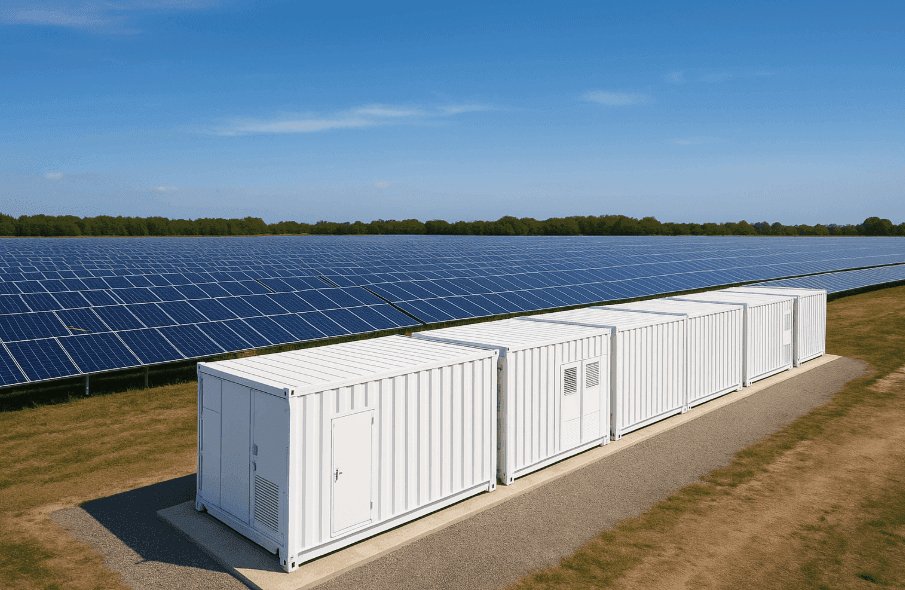
Hybrid projects need coordinated SLDs, protection settings, PCS selection, thermal management, fire safety clearances, and EMS logic. We design container or indoor placements against site constraints and document operating modes plant teams can run day-to-day.
- Chemistry and C-rate matched to duty cycle (often LFP for C&I)
- Fire safety and egress planning for battery rooms or yards
- SCADA / EMS visibility across PV and BESS
Economics that separate solar value from storage value
We present solar savings and storage value streams distinctly—energy arbitrage or peak reduction should not be blurred into one opaque number. CAPEX phasing (solar first, BESS later) is available when data proves the storage case after PV is online.
- Demand-charge and energy-cost sensitivities
- Phased investment options with clear triggers
- Financing pathways discussed for hybrid CAPEX
Single EPC accountability for PV and BESS
Fragmented vendor stacks create interface gaps. Rolling Energy delivers hybrid EPC with unified project controls—civil/electrical interfaces, commissioning scripts, and performance baselines for both generation and storage.
- Factory acceptance and site acceptance test planning
- Grid code and interconnection coordination
- Operator training on hybrid operating modes
Hybrid O&M across two asset classes
O&M covers PV soiling and inverter health plus battery thermal, SOC discipline, and PCS availability. Monitoring alerts distinguish generation faults from storage faults so response is targeted.
- Unified dashboards for solar and BESS KPIs
- Preventive maintenance calendars for both assets
- Periodic review of EMS setpoints vs tariff changes
FAQs
Questions industrial and commercial buyers ask
Do I need BESS if I already plan rooftop solar?+
Only if your bills, peaks, or export limits show a storage use case. Many sites start with solar; we add BESS when interval data supports peak shaving or shifting returns.
What size battery do industrial sites usually need?+
Size follows the use case—minutes to a few hours for peak shaving vs longer for shifting—and must be derived from load data. We do not prescribe a universal kWh-per-kW rule.
Can solar plus BESS replace diesel generators?+
Storage can reduce DG runtime for short events on selected loads, but full diesel replacement depends on critical load duration, autonomy targets, and investment appetite. We design honestly against those constraints.
Which battery chemistry do you recommend for C&I?+
Lithium iron phosphate (LFP) is commonly preferred for stationary C&I duty due to thermal stability and cycle characteristics, but final selection follows duty cycle, space, and safety requirements.
Can we use the BESS calculator before talking to engineering?+
Yes—our industrial BESS calculator helps frame order-of-magnitude needs. Final hybrid design still requires site survey, bills, and electrical study.
Ready to evaluate solar or Solar + BESS for your site?
Share your tariff, load profile, and site constraints. Our C&I team responds with next steps for survey, modeling, and commercial options.