Lithium-ion Battery Energy Storage Systems
Modular LFP or NMC rack systems engineered for industrial duty cycles, high usable energy, and long calendar life.
Battery Energy Storage · BESS
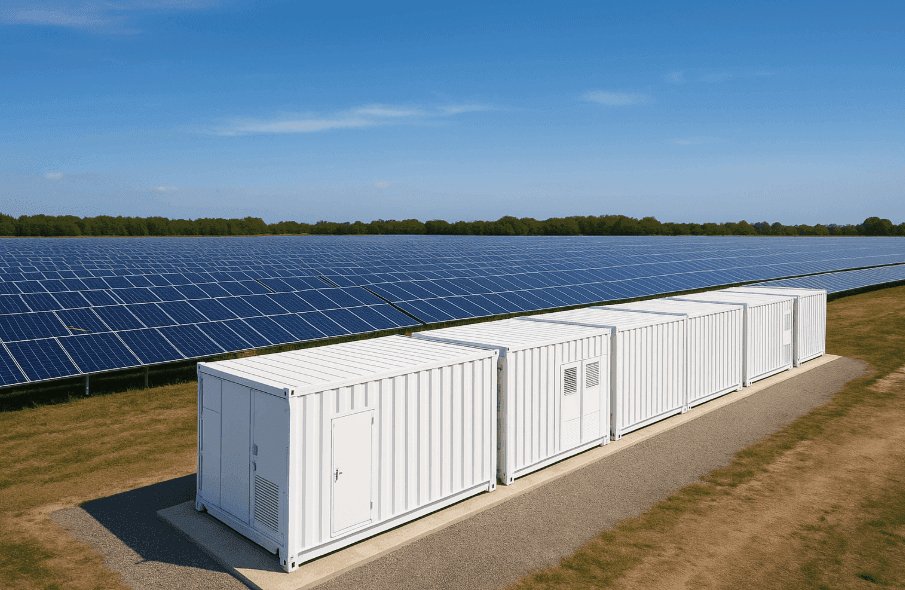
Rolling Energy delivers bankable C&I BESS—PCS, BMS, EMS, fire strategy, HVAC, containerized packages, and SCADA—paired with rooftop or captive solar for factories, warehouses, campuses, and critical facilities.
What is BESS?
A Battery Energy Storage System for industry combines chemistry, power conversion, controls, thermal management, and safety into one operable asset.
Modular LFP or NMC rack systems engineered for industrial duty cycles, high usable energy, and long calendar life.
Bidirectional inverters that charge and discharge the battery bank, synchronize with the grid, and support solar hybrid modes.
Cell/module/pack protection for voltage, current, temperature, SOC/SOH estimation, and string balancing.
Dispatch logic for peak shaving, TOU shifting, solar self-consumption, backup, and DG coordination.
Detection, suppression strategy, compartmentation, and emergency response aligned to industrial EHS expectations.
Climate control to keep cells within optimal temperature bands for safety, efficiency, and warranty compliance.
Factory-integrated containers/cabinets for faster deployment, standardized interfaces, and site-ready packaging.
Plant-level visibility of SOC, power, alarms, and KPIs for operations and energy managers.
Secure cloud dashboards, threshold alerts, and monthly performance reporting for multi-site portfolios.
Why industries need storage
C&I buyers rarely have a single problem. Demand charges punish short spikes. TOD tariffs reward shifting. Solar produces when loads may not. Diesel is expensive insurance. BESS is the flexible asset that connects those realities.
Benefits
Discharge during short demand spikes to flatten the load curve and protect contracted demand.
Lower billed maximum demand (kVA/kW) where utilities levy high demand charges.
Support critical loads during grid outages with defined autonomy windows.
Store energy in low-cost periods and discharge when tariffs or process needs are highest.
Exploit TOD / ToU differentials where applicable to improve landed cost of energy.
Absorb midday surplus PV and displace evening grid imports.
Reduce diesel run-hours and improve generator loading efficiency with hybrid controls.
Support voltage stability and controlled response for sensitive industrial loads.
Cut grid and diesel emissions with measurable MWh displaced.
Increase operational resilience against tariff shocks and grid unreliability.
Use cases by industry
Factories face demand spikes from motors, furnaces, and shift starts. BESS shaves peaks and stabilizes solar self-consumption.
250 kWh – 5 MWh
Logistics hubs combine large solar roofs with intermittent high loads (dock equipment, EV, lighting). Storage converts surplus PV into evening value.
200 kWh – 2 MWh
Clinical continuity requires engineered backup. BESS can bridge UPS/DG gaps and reduce expensive demand events.
100 kWh – 1.5 MWh
Hospitality loads peak in evenings when solar is low. BESS shifts daytime PV and supports guest experience during outages.
100 kWh – 800 kWh
Refrigeration is energy-intensive and sensitive to interruptions. Storage protects product integrity and manages demand.
300 kWh – 3 MWh
Process lines and cold chain create volatile demand. BESS improves self-consumption and protects critical utilities.
250 kWh – 2.5 MWh
Spinning, weaving, and processing loads create high daytime and peak demand. Storage pairs well with captive solar.
500 kWh – 4 MWh
OEM and ancillary plants need bankable designs, SCADA visibility, and demand control across large campuses.
500 kWh – 5 MWh+
Regulated campuses prioritize power quality, documentation, and controlled backup for critical utilities.
250 kWh – 2 MWh
Offices and mixed-use assets use BESS for demand management, backup of common services, and green certifications.
100 kWh – 1 MWh
Tech campuses need resilient power and renewable integration with enterprise energy dashboards.
500 kWh – 5 MWh
Retail peaks are evening-heavy. Storage shifts energy and supports critical common services.
300 kWh – 2 MWh
Mission-critical facilities evaluate BESS for bridging, demand management, and renewable firming alongside UPS ecosystems.
500 kWh – 10 MWh+ (architecture dependent)
Technologies
We specify LFP for most stationary C&I projects, evaluate NMC where density matters, and brief emerging options honestly.
| Chemistry | Lifecycle | Safety | RTE | DoD | Applications |
|---|---|---|---|---|---|
| LFP (LiFePO₄) | 4,000–8,000+ cycles (application dependent) | High thermal stability; industry-preferred for stationary C&I | 90–95% system (use-case dependent) | Typically 80–95% usable design DoD | Peak shaving, solar shifting, backup, DG hybrid |
| NMC | 2,500–5,000 cycles typical | Requires rigorous thermal and fire design | 90–94% | Typically 70–90% usable | Space-limited commercial campuses, backup-heavy designs |
| Sodium-ion (Emerging) | Improving; project-specific | Promising thermal characteristics | Improving toward Li-ion class | Design-specific | Future C&I pilots, cost-sensitive stationary storage |
| Flow Batteries (Overview) | Very high cycle potential; electrolyte longevity focus | Generally non-flammable electrolytes (chemistry dependent) | Often lower than Li-ion (system dependent) | Deep cycling capability | Long-duration shifting, microgrids, research deployments |
Financial benefits
Industrial BESS business cases are rarely a single line item. Rolling Energy models demand charge reduction, TOD / shifting value, diesel displacement, and PV self-consumption lift—then maps CAPEX vs OPEX/RESCO pathways.
Run industrial BESS calculatorCase studies

Pharmaceutical · 500 kWh / 250 kW PCS
An LFP containerized BESS reduced billed maximum demand and provided engineered backup for selected utilities without compromising site EHS protocols.
Savings ₹42,00,000/yr · Payback 5.2 yrs · Demand −180 kVA

Manufacturing · 1 MWh / 500 kW PCS
Hybrid solar + BESS flattened demand spikes and shifted surplus PV into evening shoulder periods.
Savings ₹95,00,000/yr · Payback 4.4 yrs · Demand −420 kVA

Textile · 2 MWh / 1 MW PCS
A power-oriented BESS prioritized demand charge reduction with secondary solar shifting on a captive rooftop portfolio.
Savings ₹1,85,00,000/yr · Payback 3.9 yrs · Demand −850 kVA

Warehouse · 800 kWh / 400 kW + 1.5 MWp PV
Warehouse hybrid design maximized PV self-consumption and trimmed evening demand without disrupting logistics operations.
Savings ₹78,00,000/yr · Payback 4.8 yrs · Demand −260 kVA

Hospital · 350 kWh / 175 kW
Hospital BESS provides a controlled bridge for selected critical loads and reduces diesel starts during short outages.
Savings ₹28,00,000/yr · Payback 6.1 yrs · Demand −95 kVA
Industrial use cases
Battery energy storage is sized to a use case—not a brochure capacity. Rolling Energy models demand charges, TOD tariffs, solar self-consumption, DG runtime, and critical-load backup before recommending PCS and energy capacity.
Discharge during short demand spikes to lower billed maximum demand (kVA/kW) without starving process loads.
Shift energy across TOD slabs where tariffs reward charging in off-peak windows and discharging in expensive periods.
Store midday surplus from rooftop or captive solar and discharge into evening or shoulder loads.
Reduce diesel runtime and improve generator loading by pairing BESS with existing DG for selected loads.
Defined autonomy for IT, clean utilities, packaging lines, or life-safety services—with clear operating protocols.
Controls, power conversion, cell safety, thermal management, and plant visibility engineered as one operable system.
FAQs
Most C&I projects are sized from site load and tariff data. Sizing depends on maximum demand, peak duration, solar surplus, critical load share, and whether the primary goal is peak shaving, backup, or energy shifting.
For most stationary industrial applications in India, LFP is preferred for thermal stability and cycle life. NMC can be considered where footprint is extremely constrained and thermal design is rigorous.
Yes. An EMS can charge from PV surplus and discharge to increase self-consumption, subject to interconnection, inverter architecture, and site protection philosophy.
The system discharges during short peaks so billed maximum demand falls. Savings depend on your utility’s demand charge structure and how predictable peaks are.
Bankable designs include BMS protections, thermal management, detection/suppression strategy, spacing, and emergency procedures coordinated with site EHS.
CAPEX maximizes long-term savings and control. RESCO/OPEX/PPA-style models can reduce upfront capital when offtake structures and counterparties are bankable.
Share your bill, maximum demand, and solar size—we’ll return a structured storage assessment.